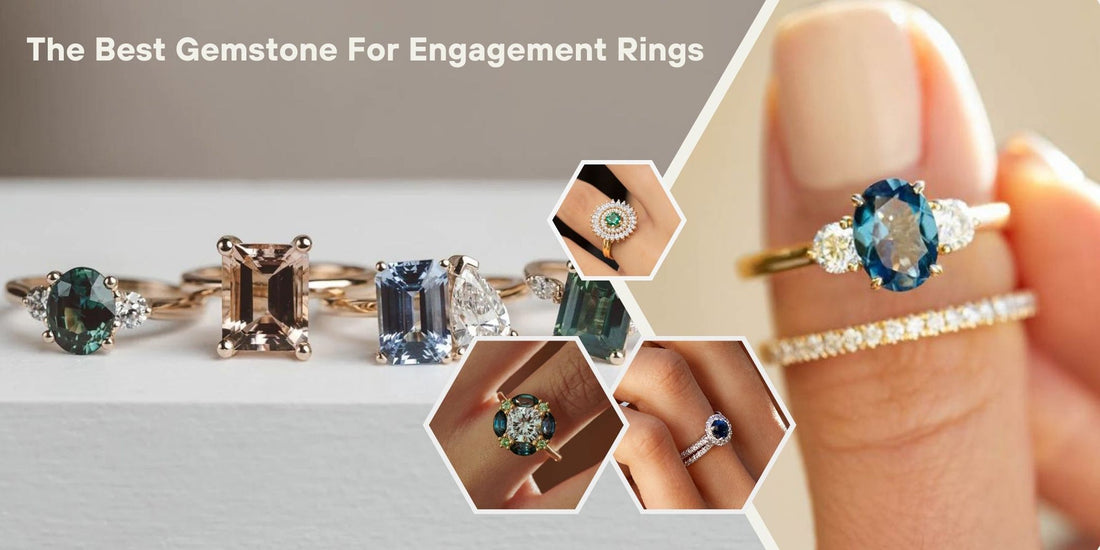
The 5 Best Gemstone for Engagement Ring
Best Gemstones for Engagement Rings (If You're Done With Diamonds)
Diamond engagement rings have always been in fashion and a favorite for everyone. But if you are looking for something that means something to your loved ones, choosing a gemstone is so much more meaningful!
Gemstones are highly expressive and an iconic way to tell you care! The attention to detail increases when you pick a gemstone. Gemstones are gorgeous, and they hold deeper meaning to the wearer’s life. Explore more on why gemstones are trending in 2026.

First — why pick a gemstone at all?
Here's the honest reason most people switch: a diamond, while gorgeous, is also kind of everywhere. Everyone's seen one. A colored gemstone instantly makes the ring feel like yours — like it was chosen, not just bought.
There's also the meaning behind it. These stones aren't just pretty — sapphire stands for loyalty, ruby for passion, emerald for renewal, and so on. Pick one that fits your story, and the ring carries a little extra weight.
And let's be real, your budget will probably thank you too. Most gemstones cost noticeably less than a diamond of the same size, and nobody glancing at your hand is going to know the difference anyway.
Alright. Let's get into it.
Sapphire — for the "classic but make it interesting" crowd
You've probably already pictured this one — that deep, royal blue. September's birthstone, and one of the toughest gems out there (a 9 out of 10 on the hardness scale, same as a ruby). That means you can wear it daily — gym, dishes, life — without worrying.
It also comes in pink, yellow, peach, and white if blue isn't your thing. Pair it with platinum or white gold for something modern, or warm gold for a vintage feel.
Price: roughly $500–$3,000 for a solid 1-carat stone. A lot of stone for not a lot of money.
Ruby — for when you want the ring to make a statement
Ruby is just... red. Bold, deep, doesn't apologize for itself. July's birthstone, and matching sapphire on the hardness scale at 9/10, so it's just as tough day to day.

The symbolism here is passion and protection — people have linked rubies to both for thousands of years. It photographs beautifully and somehow never looks dated, which is rare for a stone this dramatic.
Price: anywhere from $1,000 to $10,000+, since the really high-quality rubies are genuinely hard to find.
Emerald — for the romantic with a green thumb (literally)
That deep green just looks alive. May's birthstone, tied to renewal and growth, which honestly isn't a bad theme to start a marriage on.
One thing worth knowing: emeralds sit a bit softer on the hardness scale (7.5–8) than sapphire or ruby. That doesn't mean it's fragile — just that it prefers a gentler life. Think "treat it nicely" rather than "wear it everywhere and forget about it."
Price: $500–$5,000 per carat depending on clarity and where it's sourced from.

Aquamarine — for the calm, minimalist types
Picture the clearest, calmest ocean water you've ever seen. Now imagine that on your finger. That's aquamarine — March's birthstone, softer and more pastel than sapphire, with a dreamy quality that suits minimalist or nature-inspired settings really well.
It's associated with peace and clarity (fitting, right?) and looks especially good against rose gold.
Price: generally easier on the wallet than sapphire — a nice option if you love that blue tone but want to spend a bit less.

Moissanite — for maximum sparkle on a real budget
Let's clear something up first: moissanite is NOT a "fake diamond." It's its own gemstone, lab-created, with its own fire and brilliance — and some people will tell you, confidently, that it sparkles more than a diamond does.
At 9.25 on the hardness scale, it's nearly as tough as a diamond too. If sparkle-per-dollar is your priority, this is probably your answer.
Price: noticeably less than a diamond of the same size — often the best value on this entire list.
Morganite — for the soft-pink, vintage-romance aesthetic
If your inspiration board is full of blush pinks, dried flowers, and rose gold — yeah, this one's for you. Morganite has a soft pink-to-peach color that's become hugely popular for romantic, vintage-style rings, and it looks stunning paired with rose or warm gold.
Sitting at 7.5–8 on hardness, it's similar to emerald in terms of care — gentle is the way to go.
Price: one of the more affordable stones on this list, which makes that whole vintage-romance look easy to achieve.
Topaz — the underrated one nobody talks about
Topaz deserves way more attention than it gets. Most people know the blue version, which gives a crisp, icy look similar to sapphire or aquamarine — but at a fraction of the price. November's birthstone, sitting at 8 on hardness, so it holds up just fine for everyday wear.
It also comes in yellow, pink, and a rare reddish-orange called Imperial Topaz, if you want something a little different.
Price: one of the most wallet-friendly options here — a great pick if budget matters but you still want that blue sparkle.

So which one is your Gemstone Ring?
Quick gut-check:
-
Want timeless and tough? Sapphire.
-
Want bold and unapologetic? Ruby.
-
Want lush, dramatic, a little extra? Emerald.
-
Want calm and modern? Aquamarine.
-
Want maximum sparkle for the price? Moissanite.
-
Want soft, vintage, romantic? Morganite.
-
Want that blue look on a tighter budget? Topaz.
How to actually take care of Gemstone Ring
This part's simple, promise. Keep your ring away from harsh chemicals — cleaning sprays, pool water, hairspray — and just take it off before any of that happens. For most stones, warm water, mild soap, and a soft brush is genuinely all the cleaning you'll ever need.
If you've gone with emerald or morganite, skip the ultrasonic cleaner — stick to that gentle soap-and-water routine instead. Store your ring on its own (a lined box or soft pouch works great) so it doesn't get scratched by other jewelry, and get the setting checked by a jeweler once a year. Catching a loose prong early is a whole lot better than losing the stone later.
Quick one — which finger does Gemstone Ring go wear?
Left hand, fourth finger. That's the tradition, and it's not going anywhere. The story is that this finger connects directly to the heart — which isn't actually true anatomically, but it's been the romantic explanation for centuries, so we'll let it slide.
Questions people usually have about a Gemstone Ring
Are these stones as durable as diamonds?
Sapphire, ruby, and moissanite are all close enough on the hardness scale that it won't make a real difference day to day. Emerald and morganite are softer, so just be a bit gentler with those.
Is skipping diamonds a weird choice?
Not at all — if anything, it's becoming the norm. More couples are choosing stones based on what they actually mean, rather than just following tradition.
What's the cheapest option here?
Topaz and morganite usually come in the lowest. Moissanite wins if sparkle-per-dollar is what you care about most.
Can I mix a gemstone with diamonds?
Definitely — a colored center stone with small diamond accents around it is a really popular combination.
How do I know if a gemstone is ethically sourced?
Ask for certification — GIA is the one to look for — and ask your jeweler directly where the stone comes from. A good jeweler will answer that without hesitation.
Ready to find your Gemstone Ring?
At Rustic and Gold, every gemstone we work with is GIA-certified and ethically sourced, and our team is genuinely happy to help you find — or build from scratch — the ring that fits your story best.
Browse our Gemstone Engagement Ring Collection or reach out to start a custom design
Social Media


