What Is an Eternity Ring?
Eternity Ring: Everything You Actually Need to Know
There's a good chance you've seen one and not known what to call it. A band of diamonds going all the way around, or halfway, sitting next to a wedding ring or worn on its own. It's not an engagement ring. It's not quite a wedding band either. So what is it?
An eternity ring. And if you're trying to understand what it means when people give them, how to wear one, or how much you should be spending — you're in the right place.

So what is an eternity ring?
It's a band set with diamonds or gemstones, either going all the way around (full eternity) or across the top half (half eternity). The unbroken circle of stones is the whole point — no beginning, no end. That's what gives it the name and the meaning.
Unlike an engagement ring, which is about what's coming, or a wedding band, which marks a specific day, an eternity ring is about everything that's already happened. The years. The hard parts you got through together. The moments that didn't make it onto any invitation. It's the ring you give — or get — when a relationship has actually proven itself.
The idea goes back to ancient Egypt, over 4,000 years ago. Rings with a similar continuous design were found in tombs, meant to represent infinity. The meaning hasn't really changed.
Full eternity or half eternity — which eternity ring more sense?
This is where most people get stuck, so let's just sort it out.
A full eternity ring has stones going completely around the band. It looks incredible, and the symbolism is clean — not a single gap in the circle. The tradeoff is that it's harder to resize later, and some people find it slightly uncomfortable because there's no plain metal section on the underside.

A half-eternity ring has stones across the top of the band and plain metal underneath. You still see all the sparkle — the underside isn't exactly on display most of the time — and it's easier to resize, more comfortable for daily wear, and usually costs less because you're using fewer stones.
Honestly, if you're buying this to wear every single day, half eternity is just more practical. If it's a milestone gift that's more about the gesture and the meaning than daily comfort, full eternity hits differently.
What does giving someone an eternity ring actually mean?
It means you're marking something. That's really what it comes down to.
The most common moments people reach for one:
-
A big anniversary — first, fifth, tenth, twenty-fifth, whatever feels significant
-
The birth of a child — this is actually one of the most popular occasions for eternity rings right now
-
As an engagement ring — more couples are going this route instead of the traditional solitaire, especially if they prefer something minimal or stackable
-
A personal milestone — finishing something hard, an achievement, getting through a rough chapter together
-
Just because — increasingly, people are buying these for themselves, as a reminder of something they've worked for or survived
No rule says you need a "big enough" reason. If the moment means something to you, the ring fits.

The stones matter more than people think
Most eternity rings use diamonds because they're tough — a 10 on the Mohs hardness scale means they handle daily wear without issues. But the type of stone you pick can layer in extra meaning if that matters to you.
Sapphires have long been tied to loyalty. Emeralds to renewal and new beginnings. Rubies to passion. If you want the ring to say something specific beyond "I love you," the stone is a good place to start.
Lab-grown diamonds are also worth considering here — same optical properties, same hardness, same look as mined diamonds, just at a noticeably lower price point. For eternity rings where you're setting multiple stones around a band, that cost difference really adds up.
How the ring is set changes everything
The setting isn't just a technical detail — it changes how the ring looks, how durable it is, and how comfortable it feels.
Prong or claw setting lets the most light into each stone, which means the most sparkle. It's the most popular choice. The only thing to know is that prongs can occasionally catch on things, so you might want to have them checked annually.
Channel setting sets the stones into a metal groove, flush with the surface. Nothing snags, nothing catches. A good choice if you're rough on your jewelry or work with your hands a lot.
Pavé setting packs tiny diamonds close together with minimal metal showing between them. The whole band seems to shimmer rather than sparkle — it's a different effect, softer but really beautiful.
Bezel setting wraps each stone in a rim of metal. Very modern, very clean. The stones are the most protected in this setting, which makes it a great pick for everyday wear.
How to actually wear an eternity ring
The traditional approach on the left ring finger goes: wedding band closest to the hand, engagement ring in the middle, eternity ring on top. The idea is that marriage is the foundation; everything else builds on it.
But that's tradition, not law. Plenty of people wear their eternity ring on the right hand so the left doesn't get too crowded. Some wear it between the wedding band and engagement ring. Some wear it alone on a completely different finger. There's genuinely no wrong way to do this.

If you're stacking, a few things that help:
-
Vary the width of the bands — a thin eternity ring next to a wider engagement ring creates contrast that looks intentional
-
Different textures play well together — hammered, smooth, twisted — each one stands out more when it's next to something different
-
You don't have to keep everything in one hand if it feels too much
What should you actually spend on an eternity ring?
This varies a lot depending on metal, stone size, stone type, and whether you go full or half. Rough ranges:
Entry-level options start around $500–$800 and usually involve smaller stones or simpler settings. Mid-range lands between $1,000 and $3,000 and gets you solid quality, good craftsmanship, and a ring that looks genuinely special. Above $3,000, you're into larger stones, premium metals, or fully custom territory.
Lab-grown diamonds can significantly move where you land in those ranges. A ring that would cost $3,000 in mined diamonds might come in closer to $1,500 in lab-grown — with no visible difference in how it looks or how long it lasts.

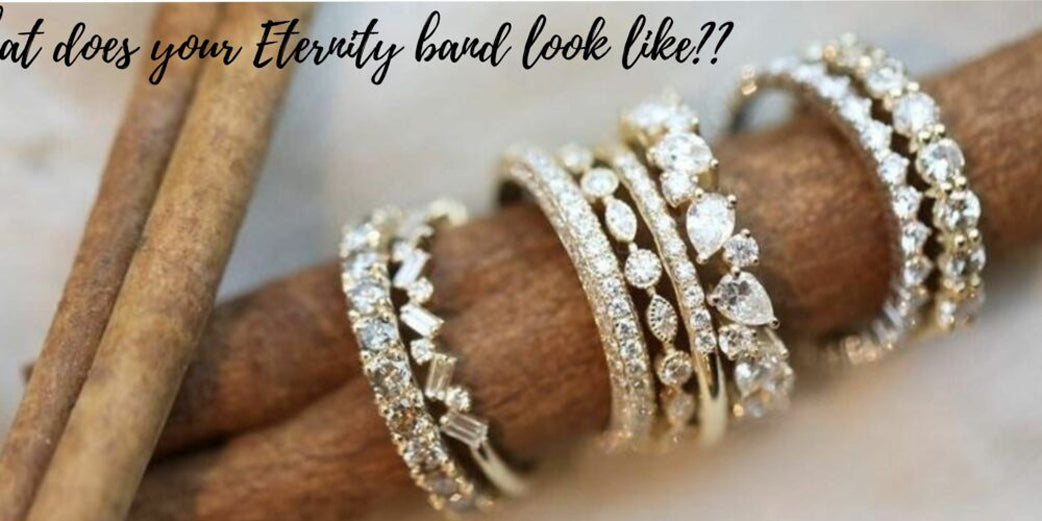
14 k Yellow Gold Half Eternity Band
Questions people search for all the time
Can you resize an eternity ring?
Half eternity rings, yes — a good jeweler can usually resize them. Full eternity rings are trickier because the stones run all the way around, which doesn't leave much room to work with. If sizing is a concern, it's worth factoring in before you buy.
What finger does an eternity ring go on?
Left ring finger is traditional, but it's your ring — wear it wherever it looks and feels right.
What's the difference between an eternity ring and a wedding band?
A wedding band marks the day. An eternity ring celebrates what came after. Wedding bands tend to be simpler; eternity rings are about the stones and the sparkle and everything that's been built since.
Do men wear eternity rings?
More and more, yes. Men's styles tend toward chunkier bands with smaller, more subtle stone settings — but the meaning is the same.
Can an eternity ring be used as an engagement ring?
Completely. It works beautifully, especially for people who want something more minimal or who plan to stack rings over time.
Find yours at Rustic and Gold
Every eternity ring we make at Rustic and Gold is crafted in solid gold or platinum, with GIA-certified diamonds — both lab-grown and natural. If you want something from our collection or have a specific design in mind, our team will work with you on every detail until it's exactly right.
Browse our Eternity Ring Collection or get in touch to start something custom
Social Media


